Persistent pain after endoscopic spine surgery does not have one explanation: the nerve may still be recovering, the original compression may remain, or the pain may come from a different source. You will learn how to classify the outcome, recognise urgent warning signs, understand the causes doctors investigate, and decide what reassessment should happen next.
Key takeaways
- Classify symptoms as unchanged, partly improved, recurrent, or newly developed.
- Seek urgent help for weakness, bladder or bowel changes, fever, or wound drainage.
- Persistent pain can result from nerve recovery, another diagnosis, or recurrent compression.
- Request examination and imaging before deciding on repeat spine surgery.
First, identify what “not working” means
If you are asking what if endoscopic spine surgery does not work, classify the result as no improvement, partial improvement, recurrent symptoms, or a new problem—not as proof of failure. Immediate postoperative pain is not a reliable test of eventual success.
A chronically compressed nerve can remain painful, numb, or weak for weeks to months after decompression, and some nerve damage is permanent.
For endoscopic spine surgery persistent symptoms, use these distinctions:
- No improvement: your original pain, numbness, or weakness remains substantially unchanged.
- Partial improvement: leg pain decreases, but numbness or back pain persists.
- Recurrent symptoms: radicular pain returns after a symptom-free interval. Recurrent disc herniation after lumbar discectomy is recognised; published reviews commonly report 5% to 18%, depending on the definition, follow-up period, and patient group.
- A new problem: a different symptom appears after surgery, rather than the original symptom simply continuing.
- A different pain source: peripheral neuropathy, hip disease, sacroiliac-joint pain, central sensitization, or another spinal level.
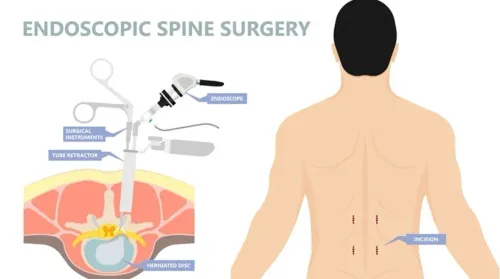
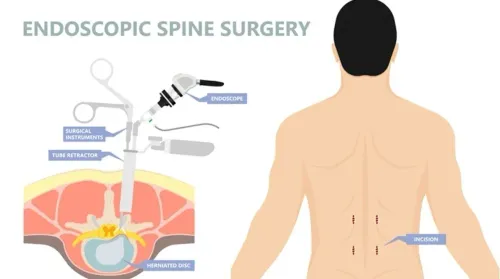
Endoscopic decompression targets a specific anatomical pain generator, usually a compressed nerve root caused by disc material or stenosis. Failure to improve does not automatically prove technical failure or justify another operation; the pain source and nerve function need reassessment.
Know which postoperative symptoms need urgent help
Pain after endoscopic spine surgery is not automatically a sign that treatment failed. Incision soreness, local back pain, temporary radiating pain, numbness, and postoperative dysesthesia can occur during recovery. A transforaminal approach can irritate the dorsal root ganglion and cause burning or shooting leg pain; it should trend toward improvement, not steadily intensify.
| Pattern | What it may mean | What to do |
|---|---|---|
| Expected recovery | Incision soreness, local back pain, temporary radiating pain, numbness, or dysesthesia that gradually settles | Follow the discharge plan and track whether symptoms improve |
| Prompt review | Fever, chills, increasing wound redness or warmth, drainage, clear-fluid leakage, persistent wound swelling, severe positional headache with nausea, or pain that worsens rather than settles | Contact the surgical team promptly |
| Emergency | New or worsening arm or leg weakness, loss of bladder or bowel control, saddle numbness, rapidly increasing swelling, severe new pain followed by weakness or sensory loss, chest pain, or breathlessness | Seek urgent medical attention; do not wait for a routine appointment |
Nerve recovery has no universal deadline. It depends on the treated nerve, how long it was compressed, the procedure performed, and the preoperative deficit; numbness or weakness can outlast pain, and some damage is permanent.
These warning signs can indicate endoscopic spine surgery complications such as a hematoma, infection, dural tear or cerebrospinal-fluid leakage, nerve injury, or recurrent compression. Progressive symptoms matter more than any single pain score.
Why symptoms can persist or return after decompression
Persistent symptoms after decompression do not automatically mean the operation failed. Endoscopic spine surgery persistent symptoms can reflect the wrong pain generator, incomplete nerve decompression, or nerve damage that occurred before pressure was removed; a chronically compressed nerve can remain painful, numb, or weak for months, and some deficits are permanent.
1. A retained disc fragment, recurrent disc herniation, or stenosis that was not fully addressed can continue compressing the nerve. Recurrent herniation usually means disc material returns at the operated level after a symptom-free interval; residual symptoms can remain without any new fragment.
2. Endoscopic spine surgery complications can also cause ongoing symptoms, including epidural scar tissue, instability, infection, hematoma, or nerve-root injury. These problems need clinical assessment even without an emergency sign, especially when pain, weakness, or sensory change is new or worsening.
3. The pain may not come from the operated level. Hip arthritis or other hip disease, sacroiliac-joint pain, peripheral-nerve entrapment or neuropathy, central sensitization, and disease at another spinal level require separate assessment.
An abnormal MRI does not identify the pain source by itself. The finding must match the side and level, pain distribution, reflexes, sensation, and strength findings; scar or age-related narrowing can look serious while causing no symptoms. Persistent pain alone is not proof that another operation will help.
How doctors investigate failed or incomplete relief
A new history and neurological examination come first. The clinician records pain location and timing, weakness, sensation, reflexes, walking ability, and bladder or bowel symptoms. This shows whether the pattern matches the treated nerve or points to another spinal level, hip, sacroiliac joint, or peripheral nerve.
It answers what if endoscopic spine surgery does not work without assuming that another operation is needed.
| Test | What it can show | When it helps |
|---|---|---|
| Standing X-rays | Alignment, movement, or instability under load | Back pain suggests slippage or symptoms change with standing |
| MRI with and without contrast | Recurrent disc, stenosis, infection, fluid collection, or nerve compression | Persistent or recurrent symptoms need soft-tissue assessment |
| CT | Bone, foraminal narrowing, implants, and surgical anatomy | MRI is unclear or bony narrowing requires greater detail |
| Electromyography and nerve-conduction studies | Ongoing nerve-root injury, peripheral neuropathy, or entrapment | Examination and imaging do not identify the source |
An early postoperative MRI is difficult to read: inflammation, fluid, blood products, granulation tissue, and epidural scar can resemble recurrent disc material. Contrast-enhanced MRI can help distinguish scar from recurrent disc because they enhance differently, but scan timing and examination findings determine whether the images answer the question.
Endoscopic spine surgery persistent symptoms require correlation, not an isolated verdict. Order imaging for a clinical reason, then match it to the side, level, pain distribution, strength, sensation, and reflexes.
What to do before considering another procedure
Do not choose another operation from pain alone. If you are asking what if endoscopic spine surgery does not work, begin with a structured reassessment of the original diagnosis, the treated level, and your current neurological findings.
Take these records to the review:
- Operative report, including the treated level and surgical approach
- Complete medication list, including recent dose changes
- Symptom timeline showing improvement, recurrence, or new symptoms
- Copies of preoperative and postoperative MRI or CT scans
A spine specialist should match the examination with the images and assess the hip, sacroiliac joint, peripheral nerves, and other non-spinal sources. This prevents endoscopic spine surgery complications, scar tissue, or an abnormal scan from being mistaken for the true pain generator.
| Finding | Usual next step | Why it fits |
|---|---|---|
| Persistent pain with stable strength and matching recovery pattern | Graded activity, rehabilitation, medication review, or observation | A compressed nerve can need time to recover |
| Burning or electric pain without a new structural deficit | Targeted neuropathic-pain treatment | Nerve irritation can persist after decompression |
| Recurrent weakness or pain matching recurrent compression | Treat the confirmed compression | Revision addresses a demonstrated cause |
| Imaging evidence of infection, hematoma, or instability | Prompt specialist management | These findings require condition-specific treatment |
Dr Chandratej Kadam's Brain & Spine Centre can provide this type of reassessment for patients in Nashik and nearby areas. A repeat procedure is justified when symptoms, examination, and imaging identify the same treatable problem—not because pain has lasted a particular number of days or a scan looks abnormal.
Related service
Spine (ESS) is an ultra minimally invasive surgical procedure that effectively relieves chronic low back and leg pain. View service → |
Frequently asked questions
What does it mean if endoscopic spine surgery does not work?
It may mean no improvement, partial improvement, recurrent symptoms after initial relief, or a new postoperative problem. Immediate pain does not predict the final result.
Which symptoms after endoscopic spine surgery need urgent help?
Seek urgent medical assessment for new or worsening weakness, loss of bladder or bowel control, numbness around the genitals, fever, increasing wound redness or drainage, or severe pain with a rapidly worsening condition.
Why can symptoms persist or return after decompression?
Pain can persist while an irritated nerve recovers, or because of residual compression, recurrent disc herniation, spinal instability, scar tissue, or a different source of pain.
How do doctors investigate persistent symptoms after endoscopic spine surgery?
They review the original diagnosis and operation, examine strength and sensation, assess the wound, and order targeted imaging such as MRI when the findings require it.
What should you do before considering another procedure?
Report changes to your surgeon, follow the recovery plan, review medicines and rehabilitation, confirm the pain generator, and obtain a clear explanation of why another procedure is recommended.