A spine infection is not treated by choosing the smallest incision first. You need the correct diagnosis, a culture-guided antimicrobial plan, and a surgical approach that matches the infection’s location, bone destruction, neurological risk, and effect on spinal stability. By the end, you will know when endoscopic drainage is reasonable, when open surgery or fixation is safer, and what to ask before treatment.
Key takeaways
- Request two blood cultures before antibiotics when the patient is stable.
- Urgent surgery may be needed for paralysis, spinal cord compression, or sepsis.
- Endoscopy can drain infection through smaller access in carefully selected cases.
- Choose a team that provides cultures, antibiotics, decompression, and fixation when needed.
How doctors confirm the infection before choosing surgery
Two sets of blood cultures, drawn before antibiotics when the patient is stable, can identify bloodstream bacteria. A normal culture does not exclude infection.
The most reliable organism diagnosis often comes from image-guided aspiration or biopsy of the disc, vertebral body, or abscess, with aerobic and anaerobic cultures, histopathology, and tests for tuberculosis or fungi when indicated.
| Test | What it identifies | How it affects surgery |
|---|---|---|
| MRI with gadolinium | Discitis, vertebral osteomyelitis, epidural or paraspinal abscess, nerve compression | Shows whether drainage or decompression is needed |
| CT scan | Bone destruction, collapse, gas, deformity, and surgical anatomy | Helps plan biopsy, drainage, bone removal, or fixation |
| Image-guided biopsy or aspiration | The causative organism and tissue type | Directs antibiotics and confirms whether endoscopic access can obtain adequate samples |
| CRP, ESR, blood count, lactate | Inflammation, treatment response, and possible sepsis | Signals systemic severity and urgency |
The examination is equally important: progressive weakness, sensory loss, gait decline, bowel or bladder trouble, fever with low blood pressure, or confusion raises concern for neurological injury or sepsis. Endoscopic spine surgery for spine infection is considered only after these findings show a reachable, localized infection without major instability or extensive compression.
If cultures suggest pyogenic bacteria, tuberculosis, fungal disease, or postoperative infection, treatment and the required operation can differ substantially. Do not let a small incision replace microbiology, MRI, and a stability assessment.
Which spine infection surgery options apply, and when is surgery urgent?
Antibiotics alone are appropriate for stable vertebral osteomyelitis or discitis without neurological deficit, drainable abscess, instability, deformity, or persistent bloodstream infection. Treatment requires culture-directed drugs and close checks of pain, neurological status, CRP, ESR, and follow-up imaging.
| Option | What it means | When it applies |
|---|---|---|
| Antibiotics alone | Medication without an operation | Stable infection without compression, instability, or treatment failure |
| Image-guided aspiration or drainage | Needle sampling or drainage of a collection | Accessible paraspinal or psoas abscess without urgent nerve compression; it also supplies culture material |
| Endoscopic debridement | A working endoscope irrigates, samples, and removes infected tissue | A contained disc-space or localized collection that the surgeon can reach safely |
| Open debridement | Direct removal of infected or dead tissue | Large, multiloculated, destructive, or inaccessible infection |
| Decompression | Removal of bone, disc, or infected material pressing on nerves | Epidural abscess, spinal-cord compression, cauda-equina compression, or worsening neurological function |
| Fixation or fusion | Screws, rods, cages, or grafts restore stability | Vertebral destruction, deformity, instability, or instability created by debridement |
Spine infection surgery options become emergency decisions when compression threatens nerve function. Seek emergency assessment for new weakness, spreading numbness, worsening walking, saddle numbness, or loss of bladder or bowel control. Fever with confusion, low blood pressure, rapid breathing, or severe deterioration suggests sepsis. Do not wait for an elective endoscopic appointment.
Persistent pain despite appropriate antibiotics, recurrent positive blood cultures, progressive deformity, or a large epidural abscess also requires prompt surgical review; decompression, debridement, and fixation may need to occur together or in stages.
What endoscopic surgery does and when it is a suitable choice
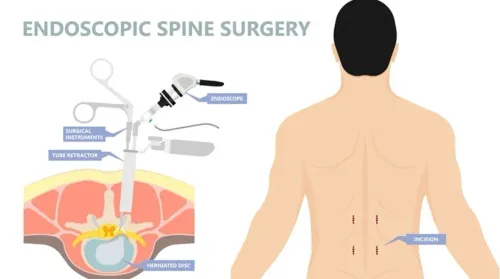
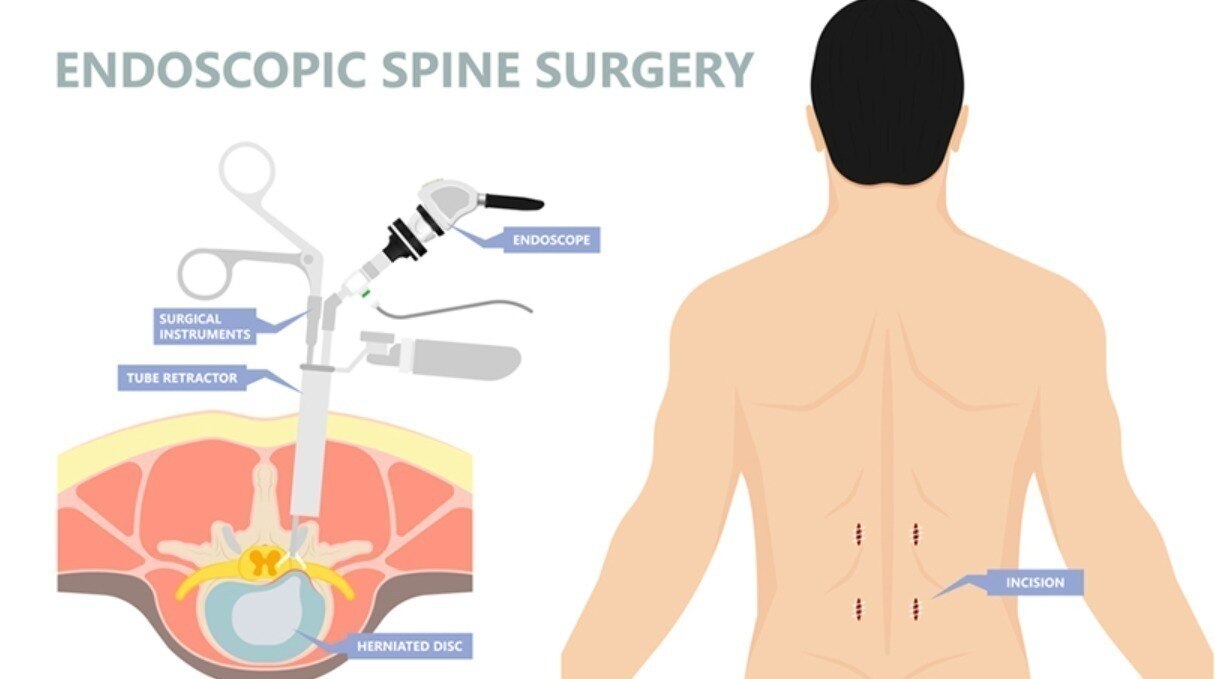
An endoscope gives the surgeon a camera and working channel through a limited route. In endoscopic surgery for spine infection, a transforaminal or interlaminar approach can drain a localized collection, irrigate and debride an infected disc space, and collect tissue for culture and pathology. This differs from routine endoscopic discectomy for a noninfectious disc herniation.
| Option | What it accomplishes | When it fits |
|---|---|---|
| Endoscopic drainage and debridement | Removes infected fluid and tissue through a working channel | A localized disc-space infection or small focal collection, limited bone destruction, stable spine, and no major epidural compression |
| Image-guided aspiration or drainage | Obtains a sample or empties a collection without direct surgical debridement | A collection is reachable by needle and does not require decompression |
| Open decompression and debridement | Relieves pressure and removes infection that the endoscope cannot reach | Large or multiloculated epidural abscess, cord or cauda-equina compression, severe destruction, deformity, or instability |
| Antibiotics with monitoring | Treats infection without an operation | No drainable focus, stable neurological findings, no instability, and improvement with culture-directed treatment |
Choose endoscopy only after MRI shows a reachable, contained target and the spine remains mechanically stable. It becomes the wrong tool for extensive epidural compression, a large or multiloculated abscess, severe vertebral destruction, deformity, instability, or infection beyond the working channel. In those situations, open decompression, debridement, and sometimes fixation provide source control and protection.
Endoscopic versus open surgery: access, source control, and fixation
A small incision does not guarantee complete source control. In endoscopic spine surgery for spine infection, the surgeon uses a transforaminal or interlaminar route to drain a contained collection, irrigate a disc space, remove infected tissue, and obtain cultures.
Open surgery provides wider access when infection, bone destruction, epidural compression, or deformity extends beyond the endoscope’s reach.
| Option | Access and source control | Typical reason to choose it |
|---|---|---|
| Endoscopic debridement | Narrow working channel; drainage, irrigation, and tissue sampling | Localized infection, limited bone loss, no major instability |
| Open debridement and decompression | Direct exposure for extensive removal and nerve or cord release | Large or multiloculated abscess, severe compression, deformity, or widespread destruction |
| Combined or converted procedure | Endoscopy begins source control; open surgery completes it | Inadequate drainage, unsafe access, poor tissue yield, or unexpected instability |
The fixation decision depends on mechanical stability, not the incision size or the presence of bacteria alone. Surgeons assess vertebral collapse, deformity, abnormal movement, pain under load, and how much bone must be removed.
- No fixation: choose this when the spine remains stable after debridement and decompression. Unnecessary hardware adds operative burden without correcting a mechanical problem.
- Same-session fixation: use it when collapse, deformity, instability, or extensive bone removal threatens alignment immediately. Instrumentation can accompany infection surgery when source control and stability require both.
- Staged stabilisation: consider it when sepsis, poor tissue condition, uncertain source control, or medical instability makes reconstruction unsafe at the first operation. Persistent infection or later collapse can still require a second procedure.
These spine infection surgery options are selected after imaging, cultures, neurological examination, and a plan for antibiotic treatment—not by incision length alone.
How to choose a complete spine infection service in Nashik
Before accepting an endoscopic plan, ask what happens if MRI shows extensive bone destruction, an epidural abscess, or spinal instability. Complete spine infection treatment in Nashik requires more than a minimally invasive technique: it needs urgent imaging, microbiology, drainage, decompression, fixation, infectious-disease input, and structured follow-up.
Ask the spine infection surgeon in Nashik:
- Will you obtain two sets of blood cultures before antibiotics when I am stable, and send biopsy or drainage material for bacterial, tuberculosis, fungal culture, histopathology, and molecular testing?
- Will MRI of the affected spine with and without contrast be reviewed for disc, vertebral, epidural, and nerve compression?
- If blood cultures are negative, who performs CT-guided biopsy or aspiration?
- What symptoms require emergency admission rather than an elective endoscopic procedure?
- How will you assess instability or deformity, and when would you add screws and fusion?
- Who selects the antibiotic, checks CRP and ESR, monitors kidney or liver toxicity, and confirms the treatment duration?
- Which examination, blood tests, and repeat imaging will determine whether the infection has cleared?
| Option | What it means | When it applies |
|---|---|---|
| Antibiotics alone | Culture-directed drugs with surveillance | Stable patient without compression, instability, or treatment failure |
| Image-guided drainage | Needle aspiration or catheter drainage | Accessible collection needing source control |
| Endoscopic debridement | Limited tissue removal, irrigation, or drainage | Localised infection reachable through a safe corridor |
| Open decompression and fixation | Direct abscess removal plus stabilisation | Weakness, bowel or bladder changes, deformity, instability, or extensive destruction |
Dr Chandratej Kadam's Brain & Spine Centre should be judged by how clearly it answers these contingency questions, not by the word “endoscopic” alone. New weakness, saddle numbness, gait deterioration, or bladder or bowel dysfunction requires emergency assessment.
Related services
Spine (ESS) is an ultra minimally invasive surgical procedure that effectively relieves chronic low back and leg pain. View service → |
Spine Cervical spine infections cause neck pain, stiffness, and decreased range of motion. View service → |
Frequently asked questions
How do doctors confirm a spinal infection before surgery?
Doctors use MRI with contrast, blood tests, two blood culture sets before antibiotics when stable, and image-guided biopsy or surgical tissue cultures when blood cultures are negative.
When is spine infection surgery urgent?
Surgery becomes urgent with progressive weakness, paralysis, spinal cord or nerve compression, spinal instability, an epidural abscess, sepsis, or infection that does not respond to antibiotics.
When is endoscopic surgery suitable for a spine infection?
Endoscopic surgery suits selected patients when the infected area is accessible, adequate drainage and decompression are possible, and the spine does not require extensive reconstruction.
How does endoscopic surgery compare with open surgery for spinal infection?
Endoscopy uses smaller access, while open surgery provides wider exposure for extensive source control, severe bone destruction, deformity correction, or instrumentation and fusion.