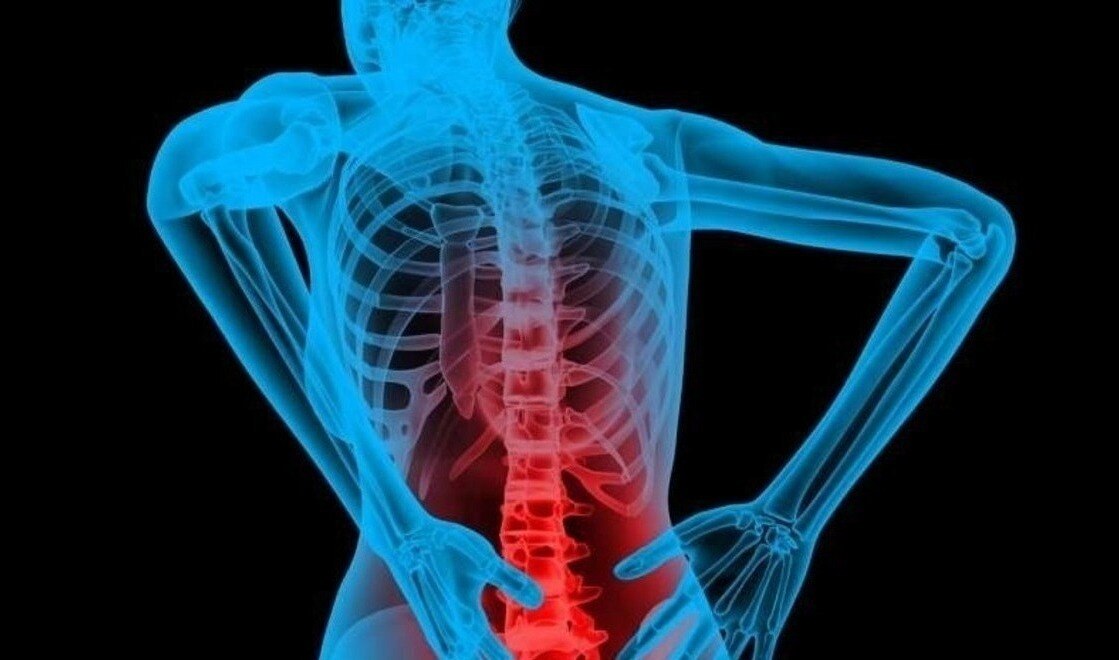
Older age alone does not rule out endoscopic spine surgery, but a small incision does not make every spinal problem suitable for it. By the end, you will know how surgeons weigh frailty, walking ability, cognition, bone health, symptoms, scans and surgical alternatives before recommending treatment.
Key takeaways
- Age alone does not rule out endoscopic spine surgery.
- Confirm that your symptoms match a problem treatable through a small endoscopic access route.
- Review heart, lung, medication and bone-health risks before surgery.
- Compare endoscopic surgery with injections, medication, rehabilitation and open procedures.
Does age alone make endoscopic spine surgery unsuitable?
Age alone does not make endoscopic spine surgery unsuitable. Is endoscopic spine surgery suitable for older adults? Often, yes—when the symptoms, scan, general health and personal goals support it.
An independent 80-year-old who walks outdoors, manages daily activities and thinks clearly may face less risk than a frail 68-year-old who rarely walks, needs help bathing or has repeated falls. Endoscopic spine surgery for elderly patients still requires a practical assessment of:
- Walking ability, balance and frailty
- Activities of daily living and available home support
- Memory, cognition and delirium risk
- Nutrition, weight loss and anemia
- Kidney function, diabetes and medication burden
- Heart and lung reserve, including sleep apnea
- Anticoagulant or antiplatelet medicines
- The person’s goals, such as walking farther, reducing leg pain or avoiding prolonged rehabilitation
A small incision does not remove anesthesia risk. Your team must plan airway management, blood-thinner changes, glucose control and safe mobilisation after surgery; never stop a prescribed medicine without the prescribing clinician. Recovery planning matters because discharge, physiotherapy and supervision can determine whether the operation delivers useful independence.
Do not wait for an elective endoscopic opinion if you develop new bladder or bowel dysfunction, saddle numbness, rapidly worsening weakness or severe bilateral neurological symptoms. Seek emergency assessment immediately, because these signs can indicate major nerve compression or cauda equina syndrome.
Which spinal problems fit an endoscopic approach?
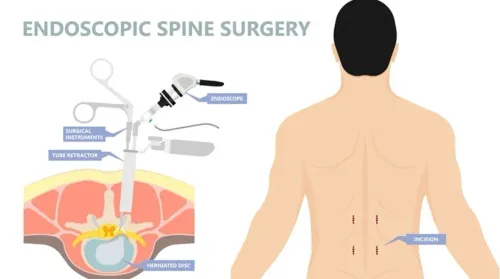
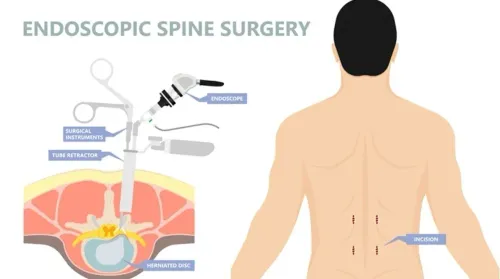
An endoscopic approach fits a focal problem: one accessible nerve is compressed, and relieving that pressure is the main goal. The strongest examples are a contained lumbar disc herniation pressing on one nerve root, or selected lateral-recess and foraminal stenosis causing leg-dominant pain or walking-limited neurogenic claudication.
The symptoms and neurological examination must match the nerve shown as compressed on MRI. An abnormal scan alone is not a reason to operate; disc bulges, narrowed joints and other degenerative findings are common in older adults without symptoms.
- Focal disc herniation with matching sciatica
- Lateral-recess stenosis affecting one nerve root
- Foraminal stenosis causing leg pain, numbness or limited walking
| Pattern | What it suggests | Likely discussion |
|---|---|---|
| One compressed nerve with matching symptoms | Focal disease | Endoscopic decompression may fit |
| Instability or significant spondylolisthesis | The spine moves abnormally | Wider decompression, fixation or fusion |
| Major deformity or severe central or multilevel stenosis | More than one structure needs treatment | Conventional decompression, fusion or another approach |
| Infection, tumor or fracture | A structural or systemic condition needs treatment | Urgent specialist-led treatment |
| Severe osteoporosis or spinal-cord compression | Endoscopy may not address the main danger | Another operation or treatment plan |
Endoscopic decompression is more reliable for nerve-related leg pain than for nonspecific axial low-back pain. It does not stabilize an unstable spine or correct major deformity, so the relevant spine surgery options for older adults may include physiotherapy, injections, open decompression, fixation or fusion rather than a smaller incision alone.
What examinations determine whether the operation is safe and appropriate?
A smaller incision does not remove anesthesia or medical risk. A proper suitability assessment should include these checks:
1. The surgeon should test strength, sensation, reflexes and gait, and look for spinal-cord involvement. Review the MRI alongside your symptoms and examination; a compressed nerve on the scan matters only when it matches the pain, numbness or weakness pattern.
2. Obtain standing front-and-side X-rays to assess alignment and reveal spondylolisthesis. Flexion-extension X-rays show whether vertebrae move abnormally, which can indicate instability that decompression alone will not correct.
3. Use CT when MRI does not show enough bone detail. It can clarify the facet joints, a fracture or bony narrowing that could affect the surgical approach.
4. Request a bone-density test, such as a DEXA scan, when osteoporosis is suspected, especially if implants or fusion may be needed. Low bone density increases risks such as screw loosening, implant subsidence, vertebral fracture and failed fusion.
5. Complete medical clearance covering the heart, lungs, kidneys, blood count, diabetes, anticoagulant and antiplatelet medicines, airway risk, delirium risk and safe walking after surgery. Coordinate every medication change with the prescribing clinician; do not stop treatment independently.
This review also identifies endoscopic spine surgery risks that a scan alone cannot predict, including anesthesia complications and unsafe recovery at home.
How does endoscopic surgery compare with other choices for older adults?
Endoscopic decompression is worth comparing with every reasonable alternative, not treating it as automatically better because the incision is smaller.
| Option | Main trade-off | When it fits |
|---|---|---|
| Endoscopic decompression | Smaller wound, less muscle disruption, lower blood loss and shorter hospital stay; limited working space | Focal nerve compression |
| Continued non-surgical care | Avoids procedural risks, but symptoms may persist | Stable symptoms without progressive weakness |
| Physiotherapy or exercise | Improves strength and function without surgery | Appropriate when pain and weakness are manageable |
| Selected injections | May provide temporary relief; they do not remove all compression | Diagnostic or short-term symptom control |
| Microscopic or conventional minimally invasive decompression | More access, with potentially more tissue disruption | Broader nerve-root decompression |
| Open decompression | Widest access, with greater recovery demands | Severe or multilevel narrowing |
| Fusion | Adds stability but requires implants and bone healing | Instability, deformity or significant spondylolisthesis |
Published comparisons often find similar pain and disability improvement after endoscopic and conventional decompression, not a dramatic endoscopic advantage. Results depend heavily on patient selection and surgeon experience; incomplete decompression can require revision or conversion to open surgery.
The endoscopic spine surgery risks include infection, bleeding or epidural hematoma, dural tear with cerebrospinal-fluid leakage, nerve-root injury, postoperative dysesthesia, recurrent disc herniation or stenosis, persistent pain, anesthesia complications, blood clots and inadequate decompression.
Osteoporosis matters most when fusion is considered. Low bone density increases screw loosening, implant subsidence, vertebral fracture and failed fusion, so bone health requires assessment rather than being dismissed because the access wound is small.
What should you verify before choosing a spine surgeon in Nashik?
Ask a spine surgeon in Nashik to answer the decision, not just describe the procedure. The key question is: is endoscopic spine surgery suitable for older adults? Your consultation should identify the compressed nerve, show how examination findings match the MRI, and explain whether instability, deformity or severe stenosis changes the plan.
Ask for clear answers to these points:
- What is the expected improvement in leg pain, and what is the separate likelihood of improving axial back pain?
- Would dynamic X-rays or CT show instability, deformity or bone narrowing that endoscopy would not correct?
- What are the alternatives: physiotherapy or exercise, an injection when appropriate, microscopic or open decompression, fusion, or continued nonoperative care?
- What is the chance of incomplete decompression, revision surgery or conversion to a larger operation?
| Option | Main purpose | Question to settle |
|---|---|---|
| Endoscopic decompression | Relieves focal nerve compression | Is one accessible nerve causing the symptoms? |
| Microscopic or open decompression | Provides wider access | Does severe or multilevel narrowing need more exposure? |
| Fusion | Adds stability | Is instability, deformity or removal of stabilising bone involved? |
| Nonoperative care | Avoids surgical risk | Have symptoms and function failed to improve with appropriate treatment? |
Verify the surgeon’s current registration through India’s National Medical Commission, then ask about specific endoscopic training and recent case volume. Confirm that the hospital provides MRI review, anaesthesia assessment, emergency neurological care and revision surgery.
Dr Chandratej Kadam's Brain & Spine Centre is one local source for specialist assessment; location alone proves neither expertise nor suitability. Choose endoscopy when symptoms, imaging, health and goals align—not merely for a smaller incision.
Related service
Spine (ESS) is an ultra minimally invasive surgical procedure that effectively relieves chronic low back and leg pain. View service → |
Frequently asked questions
Does age alone make endoscopic spine surgery unsuitable?
No. Suitability depends on the spinal diagnosis, symptoms, scan findings, general health, medications, bone health and treatment goals rather than age alone.
Which spinal problems fit an endoscopic approach?
An endoscopic approach can fit selected cases of nerve compression from a herniated disc or narrowed foramen. The surgeon must confirm that the problem is reachable and that the planned decompression will address it.
What examinations determine whether the operation is safe and appropriate?
Assessment can include a neurological examination, MRI or CT imaging, blood tests, electrocardiography, anaesthesia review and checks of lung function, blood-thinning medicines, diabetes, bone health and mobility.
How does endoscopic surgery compare with other choices for older adults?
Compare it with medication, physiotherapy, targeted injections, observation and open or microscopic surgery. The right choice depends on pain severity, weakness, instability, spinal deformity, anaesthetic risk and your goals.
What should you verify before choosing a spine surgeon in Nashik?
Verify the surgeon’s relevant training, experience with your specific diagnosis, proposed approach, complication rates, hospital facilities, anaesthesia support, follow-up plan and alternatives to surgery.