Pain after a fall, crash, or sudden impact does not by itself determine whether endoscopic surgery is safe. By the end, you will know which injury patterns may suit focal decompression, which require stabilisation, and which symptoms demand emergency assessment before any elective procedure.
Key takeaways
- Endoscopy fits best when one nerve is compressed without spinal instability.
- Fractures, dislocations, cord injury, or instability often require trauma surgery.
- MRI and CT findings must match your neurological examination.
- Choose a specialist who treats both endoscopic and traumatic spine conditions.
Start with the injury pattern, not the pain score
A focal nerve problem is the main setting in which endoscopic surgery may fit after an injury. The practical question—“is endoscopic spine surgery suitable after spine for injury”—cannot be answered from pain intensity alone.
A selected traumatic disc herniation or foraminal compression may be treated through an endoscopic corridor when the vertebrae remain aligned and stable. A burst fracture, fracture-dislocation, major ligament disruption, penetrating injury or spinal-cord compression can require open decompression, fixation or fusion instead; an endoscope cannot restore a collapsed, unstable load-bearing column.
Seek emergency assessment rather than an elective endoscopic consultation if you have:
- New or worsening weakness in an arm or leg
- Loss of bladder or bowel control, or saddle numbness
- Rapidly spreading numbness or inability to walk
- Breathing difficulty after a neck injury
- Severe neck or back injury with suspected spinal-cord damage
CT defines fracture lines, displacement, alignment and bone pressing into the canal. MRI shows the spinal cord, discs, nerve roots, epidural blood and injured ligaments. Examination of strength, sensation, reflexes and walking helps determine urgency; standing or flexion-extension radiographs can assess suspected instability after the acute phase.
Acute spinal-cord injury may need decompression and stabilization within 24 hours when medically feasible, regardless of incision size. A surgeon should explain when endoscopy is inadequate and offer conventional trauma surgery when the injury pattern demands it.
How suitability changes by injury type
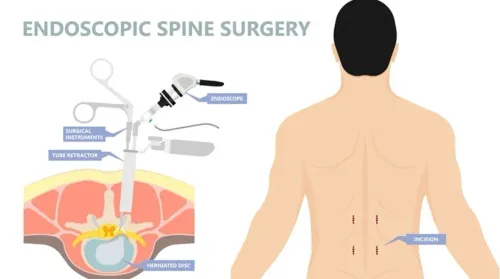
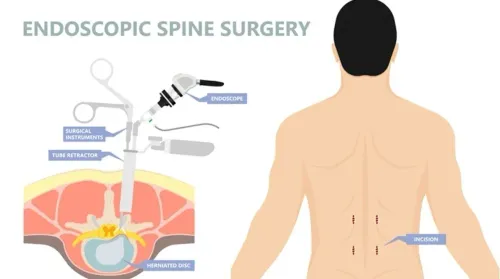
Endoscopic decompression is most suitable when the injury creates one focal pressure point, such as a disc fragment pressing on a nerve root, while the spinal column remains aligned and stable. It removes pressure; it does not restore load-bearing strength or correct a displaced vertebra.
| Injury pattern | Endoscopic role | Usual treatment direction |
|---|---|---|
| Stable compression fracture | Does not repair the fracture; consider it only for a separate, persistent focal nerve compression | Observation, bracing, pain care, or fracture-specific treatment |
| Burst fracture | Rarely suitable alone; canal fragments, deformity, or instability change the operation | CT-defined stable injuries may be observed; unstable injuries commonly need fixation, with decompression when nerves are compressed |
| Fracture-dislocation | Not appropriate as standalone decompression | Urgent reduction and fixation, often with fusion |
| Traumatic disc herniation | Possible in a stable spine with isolated nerve-root compression and no major fracture | Selected endoscopic or conventional discectomy |
| Epidural haematoma | Focal endoscopic evacuation is possible in carefully selected cases | Urgent decompression when neurological function is worsening |
| Penetrating injury | Not an elective endoscopic case | Emergency trauma assessment, wound management, and surgery when the cord, dura, bone, or vessels are injured |
| Spinal cord injury | The priority is rapid cord decompression and stabilisation, not the least invasive route | Early surgery, within 24 hours when medically feasible, should be offered as an option for adults with acute spinal cord injury |
Endoscopic spine surgery after injury is unsafe as a default choice when there is translation, progressive deformity, posterior ligament disruption, extensive fracture fragmentation, or cord compromise. New weakness, bladder or bowel loss, saddle numbness, inability to walk, or breathing difficulty after a neck injury requires emergency assessment.
The scans and examination that decide the route
A surgeon can recommend an endoscopic corridor only when imaging identifies a focal structure to decompress and shows that the spinal column does not need reconstruction or immediate stabilization.
1. CT must define the fracture pattern, vertebral alignment, canal narrowing, posterior-element injury and any translation or dislocation. Significant burst-fracture retropulsion, fracture-dislocation, progressive deformity or major loss of alignment points toward fixation, not isolated endoscopic decompression.
2. MRI must show whether a disc fragment, nerve-root compression, spinal-cord compression, cord signal change, epidural haematoma or posterior ligamentous complex injury is present. An apparently simple traumatic disc herniation is not suitable until MRI excludes hidden ligament damage, blood and cord injury.
3. The neurological examination must document strength, sensation, reflexes, gait, coordination and bladder or bowel function. New weakness, worsening numbness, inability to walk or sphincter loss demands urgent assessment; it is not a reason to wait for elective endoscopy.
4. Stability testing must show that normal loading will not cause abnormal movement. Standing radiographs, or flexion-extension views when safe and appropriate, can expose instability that a lying-down scan misses. Do not perform motion testing when an unstable injury is suspected.
The target must also be reachable through a safe transforaminal or interlaminar route. If decompression would leave the spine unstable, or the endoscopic view cannot safely address the cord, fracture or bleeding, the correct operation may be open, percutaneous or hybrid fixation with decompression.
Endoscopic decompression versus trauma surgery
Endoscopic decompression removes pressure from a nerve or spinal cord; it does not restore a displaced vertebra or stabilise an unstable column. It fits a focal disc fragment or foraminal compression when CT and MRI show alignment, load-bearing stability and acceptable neurological risk.
| Option | What it does | When it applies |
|---|---|---|
| Endoscopic decompression | Removes a disc fragment or bone through a small corridor | Selected stable injuries with one focal nerve-root or limited cord compression |
| Open decompression | Exposes and clears a wider area of canal or cord pressure | Extensive compression, epidural haematoma, severe neurological deficit or complex trauma |
| Tubular surgery | Uses a small muscle-splitting passage for decompression, sometimes with fixation | Focal compression when a larger working channel is needed |
| Percutaneous fixation | Places pedicle screws and rods to hold fractured segments aligned | Selected thoracolumbar fractures; it stabilises but does not equal endoscopic decompression |
| Fusion | Joins unstable segments to prevent movement | Fracture-dislocation, progressive deformity, major ligament disruption or instability |
A stable compression fracture with nerve-root symptoms may permit decompression, but an unstable burst fracture, translation or posterior ligamentous complex disruption usually needs fixation, with or without fusion. Treating those injuries through an endoscope alone risks worsening deformity, persistent compression and neurological injury.
Risks remain even in a suitable case: dural tear, nerve or cord damage, infection, bleeding, recurrent disc material and incomplete decompression.
Choose a specialist who reviews trauma CT and MRI, examines stability and offers conventional surgery when needed; a consultation limited to endoscopic procedures can favour cases that fit the technique rather than the safest spine injury surgery options.
How to choose the right specialist and next step
Choose an endoscopic spine surgery specialist who can also assess trauma and recommend fixation, fusion, or open decompression when necessary. A narrow consultation that only offers endoscopy can favour cases suited to the technique.
Ask these questions after your injury:
- What do my CT and MRI show about fracture fragments, alignment, ligament damage, spinal cord, nerve roots, and epidural blood?
- Is my spinal column stable, and do I need standing or flexion-extension X-rays?
- Is the problem a focal disc or nerve-root compression, or an unstable injury needing fixation?
- Which transforaminal or interlaminar route would you use, and what would make you convert to conventional surgery?
- How often do you perform this route after trauma, and what are the risks of incomplete decompression, dural tear, recurrent disc, or nerve injury?
| Option | What it addresses | Main trade-off |
|---|---|---|
| Endoscopic decompression | A focal disc fragment or foraminal compression in a stable spine | Smaller access, but limited view and possible conversion |
| Tubular or open decompression | Broader nerve or spinal-cord decompression | More tissue disruption, with wider surgical access |
| Fixation with or without fusion | Instability, deformity, fracture-dislocation, or load-bearing failure | Restores alignment but uses implants and longer recovery |
A Nashik consultation at Dr Chandratej Kadam's Brain & Spine Centre can help you compare these routes using your scans and neurological examination, rather than pain alone. New weakness, bladder or bowel loss, saddle numbness, inability to walk, or breathing difficulty after a neck injury requires emergency assessment, not elective scheduling.
Related services
Spine (ESS) is an ultra minimally invasive surgical procedure that effectively relieves chronic low back and leg pain. View service → |
Spine Surgery Spine Surgery View service → |
Frequently asked questions
When is endoscopic spine surgery suitable after a spine injury?
It may suit a focal nerve problem when imaging shows a treatable compression without instability, major fracture, dislocation, or spinal cord injury.
How does the injury type affect spine injury surgery options?
A contained disc herniation or isolated nerve compression may allow endoscopic decompression, while fractures, dislocations, instability, and cord injury often require trauma surgery.
Which scans and examinations decide the surgical route?
A neurological examination, MRI for nerves and discs, and CT for bone fractures and alignment help determine the safest approach.
How does endoscopic decompression differ from trauma surgery?
Endoscopic decompression targets a specific compressed nerve through a small access route; trauma surgery restores stability, alignment, or structural support when the spine is unstable.
Related services
Spine A traumatic spinal cord injury can stem from a sudden, traumatic blow to your spine that fractures, dislocates, crushes or compresses one or more of... View service → |
Necl Cervical Lumbar Spondylosis Surgery Surgery. If conservative treatment fails or if neurological symptoms — such as weakness in your arms or legs — worsen, you might need surgery to... View service → |
Spine Spinal fixation devices provide stability and restore anatomic alignment in the treatment of fractures, degenerative disease, infection, and tumors... View service → |