Endoscopic spine surgery is not a standard operation for every child with back pain or an abnormal MRI. The decision depends on the child’s diagnosis, neurological findings, age, skeletal development, anatomy and response to nonoperative care; by the end, you will know what assessment and safeguards a suitable plan should include.
Key takeaways
- Match the spinal problem to a safe endoscopic route, not an MRI finding alone.
- Ask which MRI, CT or X-ray findings make endoscopic access safe.
- Compare recovery, growth concerns and repeat-surgery risks before choosing an approach.
- Check the surgeon’s pediatric training, hospital support and experience with the exact procedure.
When Is Endoscopic Spine Surgery Considered for a Child?
Endoscopic spine surgery for children is considered only when a specific spinal problem matches a safe endoscopic route. It is an approach, not one operation, and an MRI abnormality alone does not prove that surgery will relieve pain.
The clearest indication is a focal lumbar disc herniation causing persistent leg pain or neurological symptoms after appropriate activity modification, medication and physiotherapy. Surgery becomes more urgent with progressive weakness, severe neurological deficit, loss of bladder or bowel control, saddle numbness or other cauda-equina symptoms.
A child may be assessed for endoscopic treatment when there is:
- Selected nerve-root compression causing symptoms that match the examination and MRI
- A focal cyst or lesion that can be treated through a working channel
- A need for tissue biopsy from an accessible focal lesion
- A carefully chosen spinal infection or tumour requiring diagnosis-specific planning
The procedure may suit an adolescent with a single lumbar lesion but not a young child with a congenital malformation, tethered cord, deformity, instability, multilevel compression, tumour or infection. Those conditions can require open surgery, reconstruction or multidisciplinary care rather than routine discectomy.
Age does not create a universal minimum or maximum. The surgeon must assess the spinal level, body size, skeletal maturity, open growth plates, anatomy and previous surgery. Small pedicles, altered anatomy or scar tissue can make safe access impossible, even when the MRI finding looks treatable.
Pediatric endoscopic spine surgery should proceed only when the diagnosis, symptoms and access route align.
What Happens During an Endoscopic Spine Surgery Child Consultation?
The first appointment must establish whether a specific spinal lesion explains the child’s symptoms before surgery enters the discussion. An endoscopic spine surgery child consultation covers pain location and radiation, duration, triggers, sleep and school disruption, walking or sports limits, weakness, numbness, saddle sensation, bladder or bowel changes, fever, weight loss and injury.
The clinician examines gait, posture, spinal movement, strength, sensation, reflexes and signs of nerve-root or spinal-cord compression.
- Bring records of growth and puberty, developmental history, previous activity changes, medicines, physiotherapy, injections, operations, medical conditions, allergies, bleeding problems and anaesthesia reactions.
- The specialist reviews whether symptoms improved with appropriate non-surgical treatment and whether MRI findings match the examination. An incidental disc bulge does not prove the cause of pain.
- You should leave knowing the suspected lesion, the evidence connecting it to symptoms, why surgery is recommended or rejected, the alternative plan, and which questions remain unanswered.
The assessment also tests whether the pain follows another pathway:
| Condition | Clues the clinician checks | Why it changes the plan |
|---|---|---|
| Muscle strain | Local pain after activity, normal nerves | Usually supports rehabilitation, not surgery |
| Hip disease | Groin pain, reduced hip movement, limp | Requires hip assessment |
| Inflammatory disease | Morning stiffness, swelling, fever | May require medical investigation |
| Stress injury | Activity-related focal pain, tenderness | Needs load reduction and targeted imaging |
| Neurological condition | Cord signs, unusual weakness or sensation | May require urgent neurological referral |
Which Tests Show Whether Endoscopic Access Is Safe?
MRI is usually the starting investigation because it shows discs, nerve roots, spinal cord, infection, tumours and other soft tissues without ionising radiation. An abnormal disc bulge alone does not prove the source of pain; the MRI finding must match the examination and symptoms.
| Test | What it shows | Why it matters for access |
|---|---|---|
| MRI | Discs, nerves, cord, infection and tumours | Identifies the target without radiation |
| Standing spine X-rays | Alignment and curves under body weight | Shows deformity that changes the access plan |
| Bending X-rays | Flexibility and movement between vertebrae | Reveals flexibility or instability when deformity is suspected |
| CT | Bone, fractures, narrow corridors and complex anatomy | Maps a bony route, but radiation requires a clear reason |
| Blood tests | Markers of infection or inflammation | Supports investigation of fever, raised inflammatory markers or suspected infection |
Open growth plates, small pedicles, immature bone, the spinal level and previous surgery can make an adult-style route unsafe. A young child with deformity, tethered cord, tumour or multilevel compression needs a different assessment from an adolescent with a focal lumbar disc lesion.
- Ask whether fluoroscopy or another image-guidance system will be used, how long imaging is expected to run, and what dose-reduction measures will protect the child.
- Request additional tests when symptoms do not fit the spine, such as hip assessment, nerve studies or a formal neurological evaluation.
- Confirm the backup microsurgical or open plan. If the working channel cannot reach the lesion safely, continuing endoscopically is not a success; the operation may need conversion or cancellation.
How Is Endoscopy Compared with Observation, Open Surgery and Fusion?
After diagnosis, choose the least invasive treatment that addresses the actual cause, not simply the most modern-sounding procedure. A children spine surgery specialist should explain why endoscopy is preferable to non-operative care, microsurgery or open surgery, and what happens if access or the view is inadequate.
| Option | What it means | When it applies |
|---|---|---|
| Observation and activity modification | Reduce provoking activity, monitor symptoms and neurological findings | Mild or improving symptoms without progressive deficit |
| Medication and physiotherapy | Age-appropriate analgesia or anti-inflammatory medication, followed by guided rehabilitation | Many uncomplicated disc herniations and mechanical pain |
| Injection | Targeted medication near an inflamed nerve or joint | Selected cases after diagnosis; it is not a cure for compression or instability |
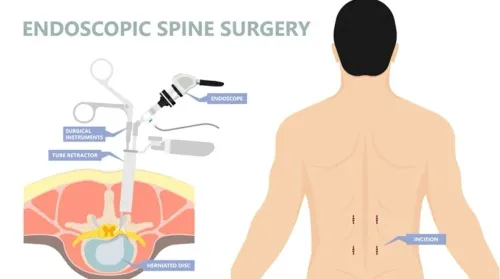
| Endoscopic decompression or disc removal | A small camera and working channel remove a focal lesion or relieve a nerve root | Carefully selected focal compression with safe anatomy |
| Microsurgery or open decompression | A larger working corridor provides direct access | Difficult access, extensive or multilevel compression, or failed endoscopy |
| Deformity correction and fusion | Realign and stabilise the spine with reconstruction | Severe deformity, instability, structural collapse or a need for reconstruction |
Open growth plates, small pedicles, undersized anatomy and previous surgery can make endoscopy unsafe. Some infections and tumours also need biopsy, wider removal or multidisciplinary treatment rather than a narrow endoscopic route.
Minimally invasive does not mean risk-free or scar-free. Incomplete decompression, recurrent disc herniation, dural tear and cerebrospinal-fluid leak, nerve injury, infection, bleeding, postoperative pain and later open surgery remain possible. Confirm age-appropriate anaesthesia, airway care, neurological observation, pain control, emergency imaging and conversion to open surgery.
Ask when the child can walk, return to school and resume sports, and whether follow-up imaging is needed. Those answers depend on diagnosis, examination, neurological recovery and wound status—not the word “endoscopic.”
How Can Families Evaluate a Pediatric Spine Surgeon in Dhule?
A suitable pediatric spine surgeon in Dhule should be assessed by training, case experience and hospital backup—not by the presence of an endoscope. Verify the surgeon’s formal specialist registration, training in paediatric spine surgery or paediatric neurosurgery, and direct experience performing the proposed procedure in children with the same diagnosis and age range.
Ask these questions before consenting:
- Which hospital provides paediatric anaesthesia, airway management, intensive-care support and postoperative neurological monitoring?
- Can the hospital arrange urgent MRI or CT and emergency open surgery if access is inadequate or a complication occurs?
- What evidence supports endoscopy for this child, and what is the alternative: observation, medication, physiotherapy, microsurgery or open surgery?
- What are the surgeon’s rates or typical experience of complications, incomplete treatment and reoperation?
- When will the child walk, return to school, resume sports and attend follow-up, and will follow-up imaging be required?
Compare the consultation against the decision it must support:
| Option | What you should hear | Warning sign |
|---|---|---|
| Endoscopic procedure | Diagnosis-specific benefit and a clear backup plan | “Minimally invasive” is the only justification |
| Open or microsurgery | Why wider access or reconstruction is safer | No explanation of alternatives |
| Referral | Named specialists and coordinated review | Congenital or complex disease treated as routine discectomy |
Dr Chandratej Kadam's Brain & Spine Centre can be one local consultation option; judge it by the child’s assessment and hospital capability. Ask how congenital tethered cord, scoliosis, instability, infection and tumours will receive multidisciplinary referral when endoscopic discectomy is unsuitable.
Related service
Spine (ESS) is an ultra minimally invasive surgical procedure that effectively relieves chronic low back and leg pain. View service → |
Frequently asked questions
When is endoscopic spine surgery considered for a child?
It is considered when a specific spinal problem matches a safe endoscopic route and the expected benefit outweighs observation, open surgery or fusion.
What happens during an endoscopic spine surgery child consultation?
The consultation connects the child’s symptoms and examination with the scans, confirms the diagnosis, discusses alternatives, and explains expected recovery and risks.
Which tests show whether endoscopic access is safe?
The surgeon reviews MRI findings and may use standing X-rays, flexion-extension X-rays or CT to assess alignment, bone anatomy, instability and the planned access route.
How is endoscopy compared with observation, open surgery and fusion?
Comparison includes symptom severity, neurological risk, spinal stability, growth, expected recovery, complications and the likelihood of needing another operation.
How can families evaluate a pediatric spine surgeon in Dhule?
Ask about pediatric training, experience with the exact endoscopic procedure, hospital and anesthesia support, alternatives, complication plans and follow-up arrangements.