The right operation depends on the problem shown on MRI, the affected nerve, spinal stability and your neurological examination—not simply on the size of the incision. By comparing each procedure, its limitations, recovery pattern and risks, you can ask more useful questions before choosing among spine surgery options in Dhule.
Key takeaways
- Endoscopic surgery uses a camera and narrow channel through a smaller incision.
- Traditional surgery may provide wider access for severe compression or spinal instability.
- Your diagnosis, MRI findings, symptoms and health determine the safest operation.
- Ask about the surgeon’s experience, alternatives, risks and expected recovery timeline.
What Endoscopic and Traditional Spine Surgery Actually Involve
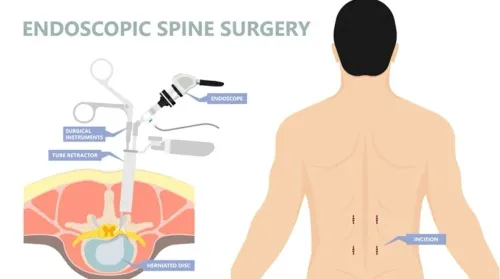
The direct difference in endoscopic spine surgery versus traditional spine surgery in Dhule is access. Endoscopic surgery uses a small incision, a narrow working channel and a camera to reach a nerve or disc.
Traditional spine surgery uses a larger exposure, with direct viewing or a microscope, to remove bone, disc material or to place implants.
| Option | What it involves | Typical role |
|---|---|---|
| Endoscopic surgery | Camera-guided work through a narrow channel | Selected disc herniation or focal nerve compression |
| Open or microscope-assisted decompression | Wider exposure to remove disc or bone | Broader stenosis or decompression |
| Fusion with screws and rods | Bone decompression plus stabilisation | Instability, deformity or painful movement requiring fusion |
Traditional spine surgery in Dhule does not mean one operation. It may describe a microscope-assisted discectomy, open laminectomy, decompression, or instrumented fusion. Endoscopy is a technique, not a guarantee of less pain, faster recovery or better results, and it cannot replace every fusion or deformity operation.
An MRI scan alone does not choose the operation. Disc bulges and narrowing occur without symptoms, so the scan level must match your pain pattern, neurological examination and suspected nerve root.
A suitable endoscopic operation also requires trained staff, specialised equipment and a plan to convert to conventional surgery if the view or decompression is inadequate.
What Happens Before, During and After Endoscopic Surgery
Before endoscopic spine surgery in Dhule, your surgeon matches the MRI level and suspected nerve root to your pain, weakness and examination. A scan alone is not enough. The consultation also covers blood thinners, diabetes, smoking, allergies and whether nonoperative treatment or a second opinion is appropriate.
1. You receive instructions about fasting, medicines and arrival time. The team confirms consent, the planned level and a backup plan if the camera view or decompression is inadequate.
2. Anaesthesia is given, and you are positioned face down for most lumbar procedures. The surgeon makes a small incision, passes a narrow working channel containing a camera, and uses instruments through that channel to remove disc material or relieve pressure on the nerve.
3. The surgeon removes the instruments, closes the incision with sutures or adhesive and checks leg strength, sensation and pain as you wake. Nurses monitor your breathing, wound and neurological status.
4. You walk when safe and receive instructions about wound care, lifting, driving, medicines and warning signs. Recovery depends on the nerve injury and operation; worsening weakness, fever, drainage or loss of bladder or bowel control needs urgent medical attention.
Which Spine Problems Suit an Endoscopic Approach
A focal lumbar disc herniation pressing one nerve root is the clearest endoscopic indication, provided leg pain and examination findings match the MRI. Selected foraminal or lateral recess stenosis can also suit an endoscopic decompression after nonoperative treatment has failed.
| Diagnosis or situation | Endoscopic fit | More suitable alternative |
|---|---|---|
| Lumbar disc herniation | Selected nerve-root compression | Microscopic or tubular discectomy when access is difficult |
| Limited foraminal stenosis | Focal decompression | Tubular or microscopic decompression for broader narrowing |
| Severe central stenosis | Usually poor fit | Microscopic or open laminectomy for wide decompression |
| Instability or spondylolisthesis | Not corrected by decompression alone | Fusion with screws and rods |
| Deformity, fracture, tumour or infection | Usually inappropriate | Open surgery, often with reconstruction or stabilisation |
Endoscopic spine surgery in Dhule is the wrong choice when several levels need decompression, the spine is unstable, or the operation requires fusion, deformity correction, tumour removal, infection control or fracture treatment. A large migrated disc can also require a microscope-assisted or open approach if the camera cannot reach and remove it safely.
MRI alone does not select the operation: disc bulges and narrowing occur without symptoms. Your surgeon must match the scan to your pain pattern, neurological examination and suspected nerve root, then discuss conversion if endoscopic access or decompression proves inadequate. Compare spine surgery options in Dhule by the problem being treated, not by incision size.
How Your Surgeon Chooses Between the Available Operations
Comparing endoscopic spine surgery versus traditional spine surgery in Dhule starts with the cause of your symptoms, not the smallest incision. A scan alone is insufficient: disc bulges and narrowing also occur in people without pain.
1. Symptoms and red flags: Match leg pain, numbness, walking difficulty or weakness to a suspected nerve root. Loss of bladder or bowel control, saddle numbness or rapidly worsening weakness requires urgent assessment, not routine elective planning.
2. Neurological findings: Muscle power, reflexes and sensation must support the MRI abnormality. A normal examination with unrelated scan changes weakens the case for surgery.
3. MRI details: Confirm the correct level, side, disc fragment, stenosis pattern and whether decompression must cover one focal area or several levels.
4. Stability: Instability, deformity, fracture, infection, tumour or a need for wide decompression and fusion with screws and rods points toward traditional surgery.
5. Nonoperative care: Review physiotherapy, activity changes, medicines and injections when appropriate. Persistent disabling pain or progressive weakness after suitable treatment can change the balance.
Spine surgery options in Dhule should also account for diabetes, smoking, blood thinners and a second opinion. Ask about comparable endoscopic case volume, specialised equipment, postoperative neurological monitoring and conversion to conventional surgery if visibility or decompression is inadequate.
Trade-Offs, Risks and Recovery After Each Procedure
Endoscopic spine surgery versus traditional spine surgery in Dhule usually offers smaller access, not a risk-free or universally better operation.
| Option | Endoscopic approach | Traditional open or microscopic approach |
|---|---|---|
| Tissue disruption | Narrow channel and camera; less muscle disruption | Larger exposure; more muscle and tissue disturbance |
| Blood loss | Usually lower for selected decompressions | Often higher, especially with extensive decompression or fusion |
| Anaesthesia | Sedation with local anaesthesia or general anaesthesia, depending on procedure | Usually general anaesthesia |
| Hospital stay | Often same-day or overnight discharge | Often overnight or longer, particularly after fusion |
| Early pain | Frequently less incisional pain | More wound and muscle pain at first |
| Complications | Dural tear, nerve injury, infection, bleeding, clot, incomplete decompression and recurrent disc | The same risks, plus greater exposure-related blood loss; fusion adds nonunion and hardware failure |
| Symptom relief | Comparable when the diagnosis and nerve compression are well matched | Reliable for suitable cases; not automatically better |
| Return to activity | Often quicker, but the operation and job determine timing | Often slower after open decompression or fusion |
A smaller incision does not guarantee faster nerve recovery. Leg pain can settle quickly, while numbness or weakness takes weeks to months; longstanding compression can leave permanent damage. Recurrence and persistent pain remain possible after either technique.
The phrase traditional spine surgery in Dhule may describe discectomy, laminectomy or fusion with screws and rods. Your neurological examination, MRI findings, spinal stability, health conditions and work demands matter more than incision size when setting restrictions and choosing between spine surgery options in Dhule.
Questions to Ask Before Choosing a Spine Surgeon in Dhule
Ask who will perform the operation, how many comparable cases they complete each year, and whether they personally handle complications. Endoscopic spine surgery in Dhule requires procedure-specific instruments, imaging, sterilisation, trained staff and a conversion plan if visibility or decompression is inadequate.
- Ask whether the hospital has emergency anaesthesia, intensive-care access and postoperative neurological monitoring.
- Request the proposed operation, spinal level, expected benefit, main risks, alternatives and recovery limits in writing.
- Confirm review of your neurological examination, MRI images, medicines such as blood thinners, diabetes and smoking status; a scan alone is not an indication.
- Ask whether nonoperative care or a second opinion belongs among your spine surgery options in Dhule.
- Ask how outcomes, infections, reoperations and complications are audited under clinical governance. Dr Chandratej Kadam's Brain & Spine Centre should be assessed by these same questions.
| Decision point | Endoscopic approach | Open or microscope-assisted approach |
|---|---|---|
| Focal nerve compression | Selected cases | Wider or complex decompression |
| Instability or deformity | Usually unsuitable | May require fusion and instrumentation |
| Visualisation or safe decompression | Convert if inadequate | Direct access may be preferable |
Related services
Endoscopic Spine Surgery Endoscopic Spine Surgery View service → |
Minimal Invasive Spine Surgery Minimal Invasive Spine Surgery Minimally invasive spine surgery (MISS) is a type of surgery on the bones of your spine (backbone). View service → |
Frequently asked questions
What is the difference between endoscopic and traditional spine surgery?
Endoscopic surgery reaches the spine through a small incision, narrow working channel and camera. Traditional surgery uses a larger opening and wider exposure, which can suit complex decompression, reconstruction or stabilisation.
Which spine problems suit an endoscopic approach?
An endoscopic approach can suit selected disc herniations and nerve compression when the location, anatomy and required treatment permit access through the working channel. Your MRI and examination determine suitability.
How does a surgeon choose between spine surgery options in Dhule?
The surgeon considers your symptoms, neurological examination, MRI findings, spinal stability, general health, previous operations and the procedure needed. Ask why the recommended operation is safer or more effective than the alternatives.
What should I ask before choosing a spine surgeon in Dhule?
Ask about the diagnosis, non-surgical alternatives, recommended technique, surgeon experience with that operation, anaesthesia, complications, hospital stay, rehabilitation and what happens if symptoms continue.