Injections calm irritated nerves or help identify the source of pain; endoscopic procedures remove or relieve specific structural compression. The better choice depends on whether your symptoms, examination and MRI or CT findings point to a treatable nerve lesion, how long the problem has persisted and whether weakness or other warning signs are developing.
Key takeaways
- Injections suit inflammation or pain testing without removing physical compression.
- Endoscopic surgery fits persistent nerve compression with matching scan findings.
- Compare expected relief, recovery time, risks, and the chance of repeat treatment.
- Seek urgent assessment for new weakness, bladder problems, or loss of bowel control.
What does each treatment target?
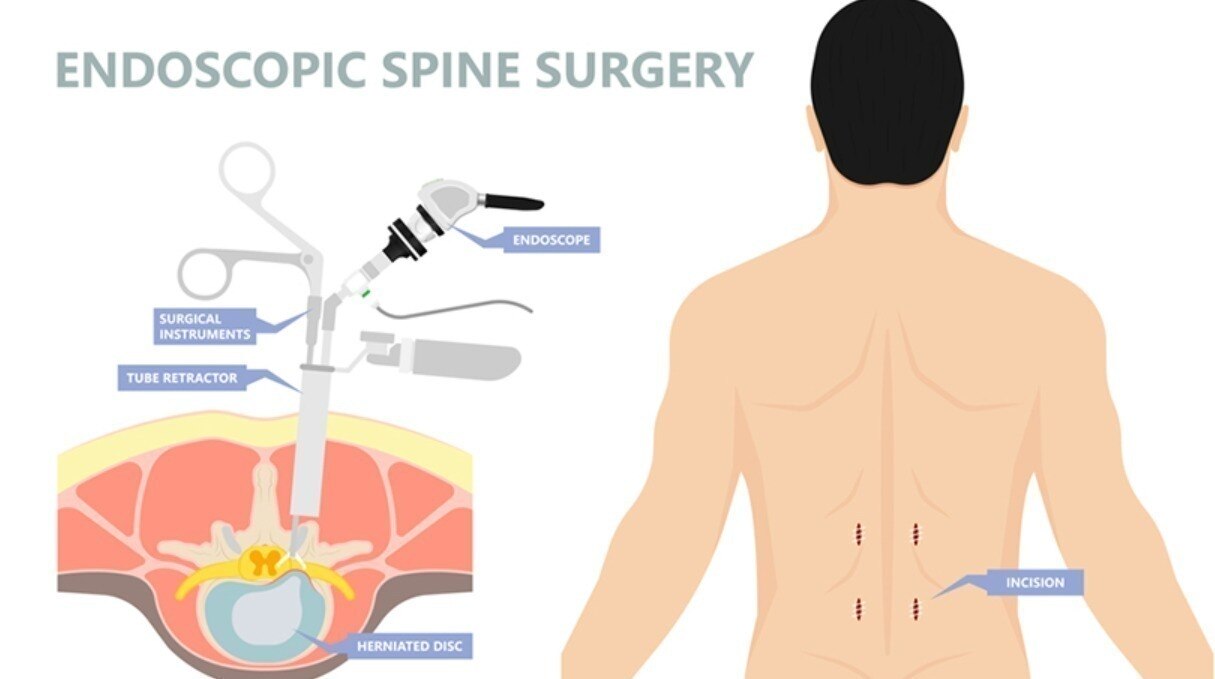
Injections target inflammation or a suspected pain generator; endoscopic spine surgery targets physical compression of a nerve. That makes endoscopic spine surgery or injections a question of matching treatment to the source of your symptoms, not choosing the “stronger” option.
| Treatment | Main target | What it does and does not do |
|---|---|---|
| Epidural steroid injection | Inflamed spinal nerves causing radiating arm or leg pain | Places steroid around the nerves to reduce inflammation; it does not remove a disc fragment or enlarge a narrowed canal |
| Selective nerve-root block | One suspected nerve root | Places anaesthetic and steroid near that root, providing temporary relief and diagnostic information; relief does not prove surgery will succeed |
| Facet-joint injection | Pain from the small joints at the back of the spine | Treats facet-joint pain; it does not treat compression of a nerve root |
| Endoscopic spine surgery | A visibly compressed nerve | Removes a disc fragment with discectomy or creates space with decompression |
Endoscopic surgery is not one operation. A surgeon may reach the problem through a transforaminal or interlaminar route; the spinal level, disc position, stenosis pattern and surgeon’s experience determine the route.
Surgery fits best when a disc herniation or focal stenosis visibly compresses the same nerve producing leg-dominant radicular pain or neurological loss. It is less predictable for isolated, nonspecific low-back pain without a correctable structural source.
Spine surgery versus injections is not a choice between a permanent cure and a harmless temporary measure. Each addresses a different pain generator and carries different risks.
When are injections before spine surgery a sensible first step?
An injection is a sensible first step for recent leg pain that travels along a nerve when strength is stable, symptoms remain manageable and no cauda equina warning sign is present. It can reduce pain briefly while you continue rehabilitation, activity modification and appropriate analgesic treatment, and consider endoscopic spine surgery alternatives.
Use this decision sequence:
- Confirm that pain radiates into the leg from suspected nerve irritation, rather than coming mainly from the back or facet joints.
- Check strength, sensation, reflexes and bladder or bowel function. Progressive weakness, saddle numbness or new bladder difficulty requires urgent assessment, not an injection.
- Consider a selective nerve-root block when the suspected nerve root and pain pattern do not clearly match. Temporary relief supports the diagnosis, but it does not prove surgery will succeed; no relief does not always exclude a treatable lesion.
- Reassess after an epidural steroid injection instead of booking an automatic series. Benefit is usually modest and strongest in the short term, so continued functional improvement matters more than repeating procedures.
Tell the clinician if you have diabetes, take anticoagulants, have immune suppression, an infection or another bleeding risk. Steroids can raise blood glucose. Rare but serious complications include infection, bleeding, direct nerve injury and spinal cord or brain infarction; epidural corticosteroid use is not FDA-approved in the United States.
If lumbar fusion later becomes likely, give the surgeon the injection date. An injection within roughly 30 days before fusion has been associated with higher infection risk in observational studies; findings are less consistent for decompression alone. The operating surgeon should set the interval.
When does endoscopic surgery fit better than continued injections?
Endoscopic surgery becomes the stronger option when disabling, leg-dominant pain persists despite appropriate non-surgical care, examination findings match nerve irritation or weakness, and MRI or CT shows a concordant disc herniation or focal stenosis.
For severe or persistent sciatica, surgery often provides faster relief than prolonged injections and rehabilitation. Some people improve without surgery, so longer-term pain and function can become more similar. Spine surgery versus injections is not a choice between a permanent cure and a harmless temporary treatment.
| Option | Best use | Main limitation |
|---|---|---|
| Endoscopic decompression or discectomy | Remove a disc fragment or relieve focal nerve compression | Not suitable for every level, stenosis pattern or spinal deformity |
| Continued injections | Short-term symptom control while rehabilitation continues | Does not remove a disc fragment or enlarge a narrowed canal |
| Microscopic discectomy | Established alternative for suitable disc herniation | Similar long-term pain and functional results, with different recovery demands |
Do not choose endoscopy because a scan looks abnormal or the incision is small. Disc bulges and degenerative narrowing are common without symptoms, so an imaging finding must match your pain pathway and examination.
Endoscopy is a poor fit for pain without surgically correctable compression, pain arising mainly from facet joints or diffuse degeneration, or anatomy requiring wider decompression or spinal fusion. Endoscopic spine surgery alternatives may fit better in those cases.
The minimally invasive label does not remove risks: dural tear, cerebrospinal-fluid leak, infection, bleeding, nerve injury, recurrent herniation, incomplete relief, later instability and reoperation remain possible.
How should you compare the options with a spine specialist?
Compare endoscopic spine surgery or injections by matching symptoms, neurological findings, scans and treatment history—not by pain intensity or an MRI phrase alone.
| Evidence | What to record | Why it matters |
|---|---|---|
| Symptoms | Pain below the knee, along a particular arm or leg pathway, confined to the back, or concentrated over facet joints | Distribution suggests the pain generator |
| Neurological findings | Reflex changes, numbness, foot or hand weakness, and walking difficulty | Deficits can strengthen the case for nerve decompression |
| Imaging | Exact MRI or CT level, disc location, stenosis pattern, and side of compression | Treatment fits only when the scan matches the examination |
| Previous care | Duration of symptoms, rehabilitation, activity changes, medicines, and injection response | Shows whether function improved and whether relief was meaningful but temporary |
Ask which confirmed pain generator the proposed treatment targets. Ask what could happen if you wait, what benefit the clinician expects, and which result would trigger a change in plan.
If uncertainty remains, a selective nerve-root block can test whether one nerve produces the symptoms and may provide temporary relief. Relief does not guarantee a successful operation, while no relief does not always exclude a treatable lesion.
A consultation at Dr Chandratej Kadam's Brain & Spine Centre in Dhule can help organise this symptom-imaging comparison and decide whether continued rehabilitation, an injection or surgery fits the findings. The useful question is not which option sounds less invasive; it is which option treats the confirmed source.
Related service
Spine (ESS) is an ultra minimally invasive surgical procedure that effectively relieves chronic low back and leg pain. View service → |
When should you stop comparing treatments and seek urgent assessment?
New bladder or bowel dysfunction, difficulty starting or controlling urination, saddle numbness around the inner thighs or genitals, or rapidly worsening leg weakness requires urgent medical assessment.
The issue is no longer whether to try injections before spine surgery; cauda equina syndrome or severe nerve compression can cause permanent nerve injury if surgical assessment is delayed.
Seek urgent care if you have:
- New loss of bladder or bowel control, trouble starting urination, or inability to empty the bladder
- Numbness in the saddle area around the inner thighs, buttocks, or genitals
- Weakness that is progressing, including a foot that starts catching or a leg that gives way
- Fever with severe back pain, particularly with immune suppression or a recent bloodstream infection
- Spinal symptoms with a history of cancer, suspected cancer-related compression, or possible spinal instability
| Situation | Why waiting is unsafe | Appropriate next step |
|---|---|---|
| Progressive weakness or cauda equina symptoms | Nerve damage can become permanent | Urgent surgical assessment |
| Fever, cancer history, or infection risk with spinal symptoms | Infection or tumour compression can worsen quickly | Same-day medical evaluation |
| Unclear diagnosis, worsening symptoms, or repeated brief injection relief | Treatment is not addressing the confirmed cause | Reassess diagnosis and neurological status |
When no emergency sign exists, structured care remains one of the endoscopic spine surgery alternatives: stay active as tolerated, avoid routine bed rest, follow exercise-based rehabilitation, and review analgesics with a clinician. Reassess neurological status before repeating an injection.
Frequently asked questions
What does endoscopic spine surgery target compared with injections?
Injections target inflammation or test a suspected pain generator. Endoscopic spine surgery treats physical compression of a spinal nerve by removing the source through a small access route.
When are injections before spine surgery a sensible first step?
Injections fit when symptoms suggest inflammation, the pain source remains uncertain, or you need a lower-intervention option before considering surgery. They are less useful when progressive weakness or clear mechanical compression requires prompt treatment.
When does endoscopic surgery fit better than continued injections?
Endoscopic surgery fits when leg or arm pain matches a scan showing nerve compression, symptoms persist despite appropriate non-surgical care, or weakness is worsening. Repeating injections without durable relief deserves reassessment.
How should you compare spine surgery versus injections?
Ask how well the examination and imaging identify the pain source, how long relief is expected to last, what recovery involves, the risks of each option, and what happens if the first treatment fails.
When should you seek urgent assessment instead of comparing treatments?
Seek urgent assessment for new or worsening limb weakness, numbness around the genitals or inner thighs, difficulty starting urination, loss of bladder or bowel control, or severe symptoms after significant trauma.