Endoscopy can relieve a compressed nerve after an injury, but a small incision does not make an unstable fracture safe to treat that way. By the end, you will know which symptoms require emergency assessment, which scans determine suitability, how endoscopy compares with fixation or nonoperative care, and what recovery decisions follow.
Key takeaways
- Endoscopy suits stable, focal nerve compression when the spine does not need reconstruction.
- Weakness, loss of bladder control, or saddle numbness needs emergency assessment.
- CT shows bone injury; MRI shows discs, nerves, the spinal cord, and ligaments.
- Unstable fractures need fixation or reconstruction, not endoscopy alone.
When endoscopy fits—and when the injury needs reconstruction
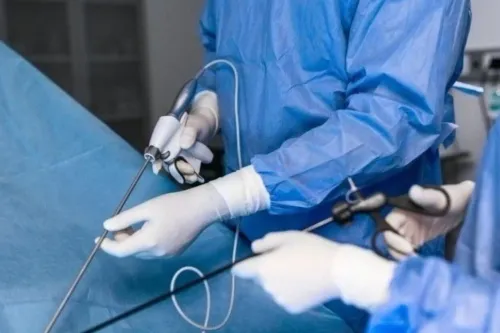
Endoscopy fits a stable, focal problem such as a traumatic disc herniation or nerve-root compression when the spine remains aligned and does not need reconstruction.
It can decompress a nerve through a small working corridor, but it does not automatically realign a displaced vertebra, stabilize an unstable spine, repair every ligament injury, or reverse established spinal-cord damage.
The question “can endoscopic spine surgery help after spine for trauma?” has a conditional answer. Endoscopic spine surgery after injury is a possible technique, not a universal trauma operation. Evidence is much stronger for selected disc herniation and spinal stenosis than for acute traumatic fractures or spinal-cord injuries, where evidence remains limited and case-specific.
These findings usually require urgent specialist assessment and may need decompression, fixation, fusion, reconstruction, or staged treatment:
- Unstable fracture, dislocation, major deformity, or major ligament injury
- Spinal-cord compression, progressive weakness, paralysis, or extensive bone fragments
- Epidural hematoma, penetrating injury, or infection
- Multilevel damage or a pattern that needs hardware to restore mechanical stability
A small incision does not guarantee safety or rapid recovery. Decompression and stabilization are separate goals: one operation may relieve pressure, while another restores alignment and stability.
An endoscopic or tubular approach can sometimes form part of that broader plan, but a purely endoscopic procedure may not provide enough access for reconstruction or severe bleeding control.
Which symptoms make this an emergency rather than a clinic visit
Call emergency services after trauma if you have severe midline neck or back pain, new weakness or numbness, loss of balance, inability to walk, paralysis, saddle numbness, or new loss of bladder or bowel control. These signs can indicate spinal-cord injury, unstable fracture, dislocation, deformity, or progressive neurological damage.
Keep the person still, maintain spinal precautions, and do not sit them up or place them in an ordinary car.
- Do not drive directly to an elective endoscopic consultation.
- Support the head and neck without forcing alignment, and avoid unnecessary movement.
- Treat penetrating injuries as emergencies; do not remove an embedded object.
- Confusion, loss of consciousness, or a head impact also requires separate brain-trauma assessment.
For someone searching for emergency spine surgery in Dhule, confirm that the receiving hospital provides 24-hour trauma assessment, CT, MRI when indicated, spine expertise, anaesthesia, intensive care, and rapid transfer when complex fixation or spinal-cord management is unavailable. Endoscopic spine surgery trauma care is not a substitute for those capabilities.
| Situation | Immediate action | Why it matters |
|---|---|---|
| New neurological symptoms | Emergency department and spinal precautions | Cord or nerve injury can worsen |
| Suspected unstable injury | Immobilisation and urgent imaging | Endoscopy may not realign or stabilise the spine |
| Stable focal nerve compression | Specialist review after emergency causes are excluded | Endoscopic decompression may fit selected cases |
How scans and timing determine the operation
Neurological examination comes first: document strength, sensation, reflexes, walking ability, and bladder or bowel changes. CT is the rapid initial scan for fractures and alignment. MRI then shows the spinal cord, discs, ligaments, nerve roots, epidural hematoma, or a cause of neurological deficit that CT cannot explain.
A normal CT does not exclude important cord or ligament injury.
Timing depends on those findings:
| Option | Usual response | Why |
|---|---|---|
| Immediate decompression and stabilization | Cord compression, worsening weakness, epidural hematoma, or mechanical instability | Waiting can leave compression or displacement untreated |
| Delayed surgery | Swelling settles, or nonoperative care fails and symptoms persist | Reassess after the spine and neurological signs declare themselves |
| Observation or bracing | Stable injury without dangerous compression or deterioration | Surgery may add risk without improving stability or function |
Flexion-extension X-rays belong only after a clinician judges movement safe and clinically appropriate; do not perform them during suspected instability. For eligible acute traumatic spinal-cord injuries, guidance recommends offering decompression within 24 hours when medically feasible. That is a timing recommendation, not a requirement to use an endoscope.
Arrange safe transport, bring prior scans and reports, and complete both imaging and specialist review. The plan can change when MRI reveals instability. Endoscopic spine surgery after injury may address a focal, stable compression, but a broader decompression or fixation may be safer.
If weakness worsens, treat the delay as an emergency rather than waiting for an elective procedure.
How endoscopy compares with fixation, open surgery, bracing, and observation
Choose the operation by asking what must be fixed: a compressed nerve, a damaged alignment, or an unstable spine. Endoscopic spine surgery trauma care fits a focal, stable nerve-root compression; it is not a substitute for reconstruction.
| Option | Main advantage | Limitation and best use |
|---|---|---|
| Endoscopic decompression | Less muscle disruption, blood loss, pain, and hospital stay | Restricted access, fluoroscopy exposure, longer operating time, and a steep learning curve; use for selected stable focal compression |
| Open decompression | Wider access to the canal, cord, and multiple levels | More muscle disruption and blood loss; use when compression is broad or anatomy is complex |
| Fixation and fusion | Restores alignment and mechanical stability | Larger operation, hardware risks, and possible staged or second surgery; use for instability, deformity, dislocation, or major ligament injury |
| Brace, observation, or rehabilitation | Avoids surgical risk | Works only for selected stable injuries or persistent symptoms without a surgical lesion; it cannot treat progressive neurological loss |
Vertebroplasty or kyphoplasty cannot remove bone or disc from the canal. Before cement treatment, assess fracture morphology, the posterior vertebral wall, and canal involvement; cement leakage can cause neurological or vascular injury.
- The exact diagnosis, spinal level, cord or nerve involvement, stability, and imaging findings
- The proposed procedure, fixation requirement, urgency, consequences of waiting, and risk of a second operation
- The hospital’s anaesthesia, intensive-care, and transfer plan if complex treatment is unavailable
For emergency spine surgery in Dhule, confirm 24-hour trauma assessment, CT, MRI when indicated, and spine expertise—not merely endoscopic availability.
Related services
Spine (ESS) is an ultra minimally invasive surgical procedure that effectively relieves chronic low back and leg pain. View service → |
Spine A traumatic spinal cord injury can stem from a sudden, traumatic blow to your spine that fractures, dislocates, crushes or compresses one or more of... View service → |
What recovery requires after trauma treatment
Persistent pain after an accident does not prove that surgery will fix a surgical lesion.
The question “can endoscopic spine surgery help after spine for trauma” has no universal answer: endoscopy is not a general treatment for post-traumatic back pain, and recovery after endoscopic spine surgery after injury depends on the original damage as much as the incision.
- Use a prescribed brace exactly as directed. Do not remove it for walking or transfers unless your clinician permits it.
- Keep the wound clean and dry, follow dressing instructions, and avoid soaking it until cleared. Attend reassessment even when the incision is small.
- Follow written limits on lifting, bending, and twisting. Do not drive until you can brake, turn safely, and take prescribed medicines without impairment; return to work only when your clinician confirms that your duties are safe.
- Complete physiotherapy as prescribed, and attend follow-up imaging when requested. Scans check alignment, healing, hardware, or continuing compression; they are not replaced by symptom improvement.
- Seek urgent review for worsening weakness, new numbness, fever, wound drainage, increasing pain, or new bladder or bowel symptoms.
Treatment may be staged: emergency decompression or stabilization first, followed later by treatment of residual nerve-root compression or pain. The safest operation that adequately decompresses and stabilizes the spine takes priority over the smallest incision; recovery also reflects the original cord, nerve, bone, and ligament injury.
Frequently asked questions
When can endoscopic spine surgery help after a spine injury?
It fits a stable, aligned spine with a focal problem such as traumatic disc herniation or nerve-root compression. It is not a substitute for reconstruction when the spine is unstable.
Which symptoms require emergency spine surgery assessment after trauma?
Seek emergency care for new or worsening limb weakness, inability to walk, loss of bladder or bowel control, saddle numbness, or severe neck or back pain after an injury.
How do scans determine treatment after spine trauma?
CT identifies fractures, dislocations, and alignment problems. MRI assesses discs, nerve roots, the spinal cord, bleeding, and ligament injury; the findings and neurological examination guide timing and the operation.
How does endoscopy compare with fixation, open surgery, bracing, and observation?
Endoscopy treats selected focal compression through a smaller access route. Fixation or reconstruction stabilizes an unstable spine, while open surgery provides wider access; bracing or observation fits selected stable injuries without progressive neurological problems.
What does recovery require after trauma treatment?
Follow the surgeon’s movement and lifting limits, wound-care instructions, prescribed medicines, and follow-up schedule. Report worsening pain, weakness, numbness, fever, or bladder and bowel changes promptly.
Related services
Spine Surgery involves the partial or total removal of the spine tumor. Spinal fusion may be used to reconstruct and stabilize the spine. View service → |
Spine Surgery Spine Surgery View service → |
Necl Cervical Lumbar Spondylosis Surgery Surgery. If conservative treatment fails or if neurological symptoms — such as weakness in your arms or legs — worsen, you might need surgery to... View service → |
Spine Spinal fixation devices provide stability and restore anatomic alignment in the treatment of fractures, degenerative disease, infection, and tumors... View service → |